
How Hydrogen Fuel Cell Trucks Benchmark Against Battery Electric Models in Competition
A report released by the North American Council for Freight Efficiency (NACFE) shows that during last year's 'Run on Less – Messy Middle' demonstration, Hyundai Xcient hydrogen fuel cell Class 8 tractors operated by Penske Logistics and Pilot demonstrated 'real operational promise' in return-to-base and long-haul freight corridors, but cost and infrastructure remain constraints.
Editor's note:This article is the third part of the North American Council for Freight Efficiency (NACFE) "Run on Less – Messy Middle" demonstration project series, which focuses on pathways and findings for decarbonization and fuel efficiency improvements. Please readPart 1andPart 2。
In a recent real-world operational demonstration, hydrogen fuel cell trucks showcased their technical performance on daily routes and revealed several advantages over battery-electric models.
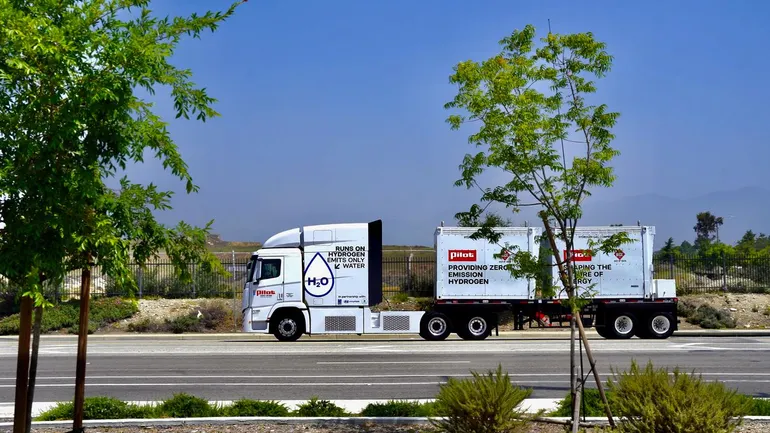
Both Penske Logistics and Pilot participated in NACFE's "Run on Less – Messy Middle" demonstration project held last year, with each using a Hyundai Xcient fuel cell Class 8 tractor. NACFE'sreport released in Marchnoted that these trucks "demonstrated genuine operational promise" in return-to-base operations and long-haul freight corridors, but also pointed out limitations in cost and infrastructure.
NACFE stated in the report: "Hydrogen fuel cells are best suited for regional operations with structured refueling conditions, applications requiring zero direct emissions, and weight-sensitive freight—where hydrogen's mass advantage can preserve payload capacity compared to batteries. When infrastructure matches, hydrogen can sustain diesel-like operational patterns without long charging waits."
"There is a right way to drive a hydrogen truck."
David Bickmeier
Pilot driver, told NACFE

The study highlighted real-world performance of diesel and alternative powertrains, rather than manufacturer-claimed data.
Two tractors, two operating environments
In the hydrogen fuel cell tractor portion of the study, participating companies operated in different environments, showcasing different application scenarios.
Notably, Penske's triangular route in the Dallas area, centered on its auto parts distribution center in Lancaster, Texas, featured mostly flat terrain. Pilot's route traversed inland foothill areas of Southern California, primarily in the Los Angeles region, extending from Thousand Oaks to San Bernardino and south to Oceanside.

The study noted that Penske demonstrated its overnight transport of automotive and retail goods, while Pilot transported revenue-generating hydrogen bulk cargo.
In terms of efficiency, the two trucks averaged approximately 7.5 and 7.8 miles per kilogram of hydrogen. Pilot benefited from California's varied terrain but saw efficiency drop on climbs. The report stated that while the trucks were speed-limited to 56 mph, their performance was strong in the 50-60 mph speed range.
High-speed range shows hydrogen's potential productivity
Speed-based operational segment fuel efficiency (approximate miles per kilogram of hydrogen for Hyundai Xcient tractors in real-world use):
- 0-25 mph:Penske 0.78, Pilot 2.1
- 25-40 mph:Penske 5.55, Pilot 7.7
- 40-50 mph:Penske 8.39, Pilot 10.8
- 50-60 mph:Penske 10.17, Pilot 11.5
Data source: NACFE
Considering terrain factors, Penske maintained 7.68 and 7.94 miles per kilogram of hydrogen on flat and gently rolling roads. On 3%-6% grades, this dropped to 5.91 miles; on steeper sections, it fell to 1.87 miles.
Similarly, Pilot's truck achieved 8.4 and 9.71 miles per kilogram of hydrogen on flat and gently rolling terrain, respectively. On 3%-6% grades and steeper terrain, mileage dropped to 7.05 and 3.24 miles, respectively.
These varying conditions highlight the technology's suitable applications and how it can best be integrated into transportation networks.
Meanwhile, Pilot told Trucking Dive that it has exited hydrogen fuel cell truck operations this year but will continue developing its alternative fuel offerings. Penske Logistics' hydrogen vehicle pilot has also concluded, but the company said it will continue testing and evaluating new technologies—as evidenced by its recent launch of thePenske Fleet Lab.
Driver feedback
Beyond terrain and infrastructure variations, drivers also noted the tractors' real-world performance. Christopher Rawles, who drove for Penske, said the vehicle was very easy to operate. "You can't hear it, and you can't feel any vibration," he said according to the report.
David Bickmeier, who drove for Pilot, described the learning process of maximizing vehicle efficiency. Initially, he averaged about 5.9 miles per kilogram of hydrogen. But he said things changed quickly.
"There is a right way to drive a hydrogen truck," Bickmeier told NACFE about his experience. "Once I learned how to drive it, I was able to achieve 9.1 miles per kilogram."

Despite these advantages, due to infrastructure limitations, the technologyappears likely to face higher costs。
NACFE concluded in the report: "The weight advantage and operational flexibility offer tangible benefits; however, scarce infrastructure and high fuel costs currently confine hydrogen to demonstration-scale deployment, requiring a high degree of coordination between fleets and infrastructure."