
Truck vs. Rail Showdown: Who Has the Upper Hand Amid Surging Spot Freight Rates?
When trucking spot rates are high, shippers begin considering rail intermodal. This article explores the competitive landscape between truck and rail, analyzing their respective strengths and limitations, and cites expert views from ACT Research, DAT, and other organizations.
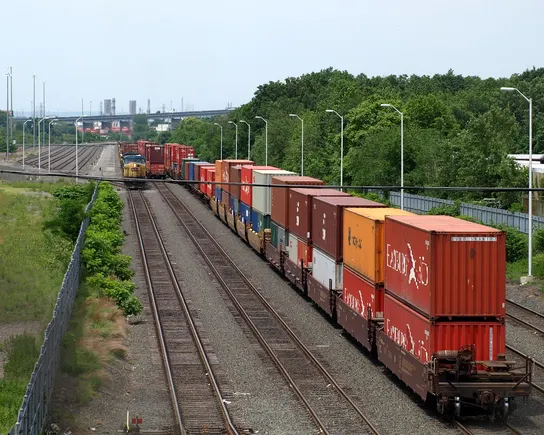
The old saying "things turn into their opposites when they reach the extreme" applies to everything from a baseball thrown into the air to many aspects of market operations. Current trucking rates are in the "rising" phase and have not yet peaked. Meanwhile, shippers are looking for alternatives—their eyes are turning to rail yards.
Rail has long competed with trucks and once carried most of America's long-haul freight. But by 1978,rail's share of intercity freight fell to 35%. Today, trucks dominate, carrying about 80% of freight volume, said Tim Denoyer, vice president and senior analyst at ACT Research.
But when truckload capacity is tight and spot rates are high (as is currently the case), shippers reconsider rail and intermodal.
Denoyer noted that a surge in imports from Asia (arriving at California ports) is partly driving the current market dynamics. U.S. imports are up 34% from May, boosted by sustained consumer demand following the initial phase of the spring COVID-19 pandemic and the need for retailers to replenish inventory.
Typically, trucks handle most long-haul import freight from ports to inland U.S. points. But trucking has faced obstacles in meeting strong demand, including the pandemicand a driver shortage.
These multiple issues (both positive and negative) have driven up truckload spot rates, increasing costs for shippers.
Trucking's advantages: speed and visibility
Higher prices have helped intermodal companies and railroads gain more freight business. But typically, these shipments are not urgent, said Dean Croke, principal analyst at DAT.
"If your freight isn't urgent, put it on a train," Croke said. Rail freight is therefore cheaper.
But only certain types of freight can easily switch between road and rail. Dry goods in containers are typically suitable for trucking and also easy for trains to handle. These include consumer goods such as clothing, electronics, sporting goods, and toys—almost anything that fits in a container can be transported by dry van.
Liquid and refrigerated goods can also be transported via intermodal, said Jim Blaze, a former Conrail employee and rail analyst.
"If your freight isn't urgent, put it on a train."

Dean Croke
Principal Analyst at DAT
Croke said that if lead times are longer, intermodal is a reasonable choice. Shippers are already thinking about next spring, and they want to stock up "because the pandemic is still ongoing." Replenishing inventory early is an ideal scenario for intermodal.
"You can let freight sit longer in the rail system," Croke said.
Highly regulated goods, such as manufactured chemicals and hazardous materials, are not suitable for intermodal, Blaze said, although there are some exceptions. Large wide-body freight is typically handled only by flatbed trucks, though some railroads can make exceptions.
Switching to rail also involves other trade-offs. Visibility through rail transport is lower, at least for shippers.
"The railroad knows exactly where your freight is," Nick Little, director of the Center for Railway Research and Education at Michigan State University, told a room full of shippers at the APICS conference in Chicago in October 2018,"but they don't tell you."
Visibility is indeed a problem, Blaze said. Automatic identification tags attached to rail freight have helped railroads speed up data entry, but these tags rely on freight passing through fixed scanners that use radio waves to capture shipments at multiple points, a process Blaze calls "interrogation." This process is often delayed because freight must pass through scanners to be tagged.
Most trucks are equipped with GPS devices that transmit signals almost in real time.
"With trucks, you have instant, continuous communication," Blaze said. "With rail, you have occasional communication."
A tale of two tight markets
Many shippers have chosen intermodal, and spot rates have risen with demand. According to Croke, intermodal spot rates in early October were $1.74 per mile, compared to a monthly average of $1.31 in May.
Overall, U.S. railroads shipped about 1.4 million intermodal containers in September, up more than 7% year-over-year,according to the latest data from the Association of American Railroads. AAR said September was the fourth-best intermodal month in history.
"Railroads are moving as much as they can," Croke said. "Just like trucking, volumes are imbalanced."
"Railroads are not going to go out and take 10% market share from trucking because they simply don't have enough equipment capacity."
Jim Blaze
Rail Analyst
Part of the imbalance is because it is more difficult for railroads to add cars. Blaze said it takes 12 to 18 months to order and receive a railcar. Truck fleets, on the other hand, can immediately buy nearly new or used trucks at sales lots.
"Railroads are not going to go out and take 10% market share from trucking because they simply don't have enough equipment capacity," Blaze said.
Railroads respond by not always quoting rates, Blaze said, because they are overwhelmed by shrinking capacity.
"Both markets are tight right now," Denoyer said, referring to trucking and rail. "What's happening is massive restocking."
This is a big shift for railroads. Denoyer said rail volumes had declined for seven consecutive quarters until turning positive in the first week of October. Intermodal spot rates in the first week of October were 61% higher than the same period in 2019.
Part of the spot increase is due to Union Pacific's $5,000 peak season surcharge on excess contract freight effective August 30, Denoyer said. The surcharge is designed to manage demand.
But weeks later, consumer demand still dominates. Denoyer said loaded TEU volumes entering U.S. ports since September 1 are up 6% year-over-year. These shipments typically end up on trucks or trains. The shipper's question is: in a freight market with tight truck capacity and longer intermodal transit times, which mode is best?
Blaze said it is relatively easy to sell truckload services to shippers against rail competitors. Intermodal and rail can take longer. Trucks are not limited by fixed rail lines and offer better visibility.
Croke said trucks have the upper hand—especially when lead times are tight.
"Shippers value service and price," Croke said. "A driver can reach a destination faster than the fastest train."