
Regulations and cost pressures make trucking companies avoid the northeastern US market
Northeastern US states continue to intensify regulations, tolls, and taxes on trucking, coupled with winter road conditions, traffic congestion, and empty backhaul issues, significantly weakening carriers' willingness to enter the regional market. The New Hampshire Motor Transport Association successfully pushed for legislative rejection of a local clean energy mandate, but Connecticut and New York are still advancing truck-specific taxes and strict regulations, with industry organizations responding through litigation and lobbying.
After multiple states in the northeastern U.S. and California successively required new residential buildings to adopt green energy heating systems, trucking industry representatives in New Hampshire filed a motion with the state legislature, attempting to prevent such regulatory trends from spreading to the state. Carriers worry that if such mandates are implemented, their propane, natural gas, biofuel, and heating oil transportation businesses would suffer significant losses.
The New Hampshire Motor Transport Association has asked Governor Chris Sununu and the legislature to return energy choices to household consumers and prohibit local governments from imposing mandatory bans on fuels such as natural gas and propane. The association is led by President and CEO Bob Sculley.
In the Northeast—a region known for regulation, tolls, taxes, and various fees targeting trucking—the association's lobbying in the state capital of Concord might have failed. However, Bob Sculley and a coalition of industry associations ultimately achieved victory in August. Local governments were required to leave the choice to consumers and residential builders. Sununu signed theSenate Bill 86into law last August.
In New Hampshire, whose motto is "Live Free or Die," rejecting such mandates is not surprising. The state, which has trended politically moderate in recent years, stands in stark contrast to much of the Northeast—often described as one of the most challenging regions for trucking.
The Northeast's Many Problems
It is not just the business environment that hinders carriers from entering the Northeast market. The region's routine seasonal climate leaves roads frequently covered with ice and snow, while traffic congestion in Boston, New York City, and New Jersey is also widespread.
On online forums, truck drivers are happy to share other problems unique to or particularly prominent in the region: low-clearance bridges, narrow roads, and numerous tolls. Carriers shipping goods into New England or the New York area often have to charge higher freight rates because the region lacks backhaul cargo, leading to increased empty miles.
Now, the regulatory environment is increasingly tightening. Northeastern state governments are accused of viewing trucking as a targeted revenue source to fill fiscal gaps.
The American Trucking Associations and several carriers are suing Rhode Island over its truck-only tolls on tractor-trailers. In September 2020, a federal judge allowed the tolls to continue being collected during the litigation. ATA and the carriers claim the tollsviolate the Commerce Clause of the U.S. Constitution。
The accumulation of multiple challenges has prompted some fleets to offer incentives for entering the region. In June,Forward Air announced increased destination compensation for fleet partners in its less-than-truckload and truckload operations. For most of the northern half of the continental U.S., solo drivers receive an additional 2.5 to 12.5 cents per mile. The only area reaching the maximum standard of 12.5 cents per mile is the Northeast.
"Long-haul drivers focus on maximizing the use of their service hours, which is critical to their personal success," said Ryan Gilliam, vice president of talent acquisition at Forward Air, in an email. "The only way to offset the lower utilization rates in New England and the broader Northeast is to increase per-mile compensation."
A Forward Air spokesperson said drivers generally believe the Northeast has higher costs for fuel, meals, repairs, and parts. Traffic congestion, and even long lines at gas stations, extend stop times. The spokesperson also noted that road conditions in the Northeast are worse than in other parts of the U.S., leading to more frequent tire and suspension repairs. Therefore, raising rates in the Northeast has indeed increased driver interest in entering the region.
Population and Businesses Continue to Flee
Connecticut was once one of the Northeast's commercial gems. Its capital, Hartford, was the insurance capital, and its southwestern suburbs were home to wealthy residents who commuted to New York City to run business empires.
The state often benefited when neighboring northeastern states raised taxes or passed regulations, mainly because Connecticut did not levy an income tax at the time. Businesses and residents moving in from Massachusetts and New York meant more retail goods needed to be delivered regularly to Connecticut destinations, with much of that freight being highly profitable.
However, Connecticut adopted an income tax in 1991 to bolster state finances, and since then, Hartford has developed a stronger regulatory culture.
Joe Sculley, president of the Motor Transport Association of Connecticut and son of Bob Sculley, said the state is now continuously losing population and the businesses that follow. The U.S. Census Bureau reports that in 2020,Connecticut's population was 3.6 million, an increase of only 0.9% from a decade earlier. In contrast, the U.S. population grew by 7.4% over the same period.
Joe Sculley does not primarily blame the population exodus on weather, or on residents moving to warm, income-tax-free states like Florida and Tennessee. He points to New Hampshire and Massachusetts—the latter once nicknamed "Taxachusetts." Joe Sculley notes that these states have the same New England weather but now offer a more favorable business climate.
"Businesses have left Connecticut for Massachusetts," Joe Sculley said. "I bet people never would have thought of that before."
Joe Sculley said that when owners of Connecticut carriers can no longer bear the state's economic and regulatory pressures, they often sell their businesses to other association members or out-of-state carriers.
"The only way to offset the lower utilization rates in New England and the broader Northeast is to increase per-mile compensation."

Ryan Gilliam
Vice President of Talent Acquisition at Forward Air
In June, the Connecticut legislature passed a highway use tax targeting trucks. The tax is expected to raise $90 million annually,and will take effect next January. For years, Connecticut Governor Ned Lamont had tried to raise revenue by first pushing truck-only tolls and then expanding to general tolls, but failed, ultimately turning to a mileage- and tonnage-based tax.
According to Marc Fitch, an investigative reporter at the Hartford-based free-market think tank Yankee Institute for Public Policy, this tax is "notoriously difficult" for carriers to collect. "They rely to some extent on the honor system to collect the tax," Fitch said.
The Empire State's Double Bind
Connecticut's passage of a truck use tax is seen as a regional blow to the trucking industry's lobbying efforts. The Trucking Association of New York lobbies annually at the state capitol in Albany, aiming to repeal a truck use fee that has been in place since the 1950s.
But Kendra Hems, president of the Trucking Association of New York, said that with Connecticut passing a similar tax, the argument for repealing New York's use fee will now be more difficult.
The Empire State also faces a double problem. Hems said that in the western part, expenses such as property are lower, but carriers must pay state tolls on Interstates 90 and 87.
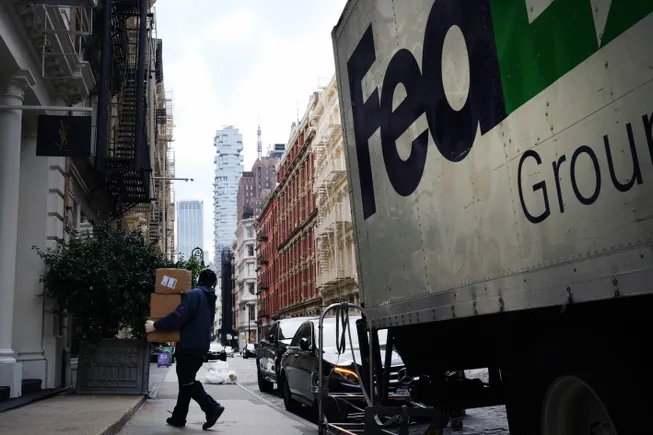
Then there is New York City. During the early days of the COVID-19 pandemic in the winter of 2020, officials in the nation's largest city were quick to praise truck drivers for delivering goods to New York City. Hems noted that more than a year later, the city's famous bureaucracy has resurfaced: commercial loading zones are shrinking (often taken over by restaurants required to add outdoor seating), and ticketing has become more aggressive. Nearby Fort Lee, New Jersey, is home to the nation'sworst trucking bottleneck.
"The environment in New York City only seems to get worse, not better," Hems said.
Hems said the double problem makes New York one of the most expensive states for trucking operations in the U.S. When asked whether the Northeast deserves its reputation as "costly and heavily regulated for carriers," Hems replied succinctly: "Yes."

Nevertheless, one aspect of the national economic recovery has made New York state officials sympathetic to the trucking industry. The state and city are facing a shortage of school bus drivers. Hems said New York officials now want to streamline the driver's license process, and she has made progress in extending licensing office hours and moving some commercial driver's license (CDL) transactions online.
New York officials are also discussing other pain points with Hems, eager to remove obstacles to improve freight flow. But Hems is well aware of the challenges of driving change. "Trucking in New York has always been challenging," Hems said.