
High freight rates prompt food shippers to enter logistics field
Persistently rising trucking rates and tight capacity are profoundly impacting the food supply chain. Facing high spot rates for refrigerated trucks, equipment shortages, and transportation delays, food producers and ranchers are adopting strategies such as shifting to less congested ports, expanding in-house transportation fleets, and enhancing communication with upstream and downstream partners to mitigate market shocks and ensure cargo delivery.
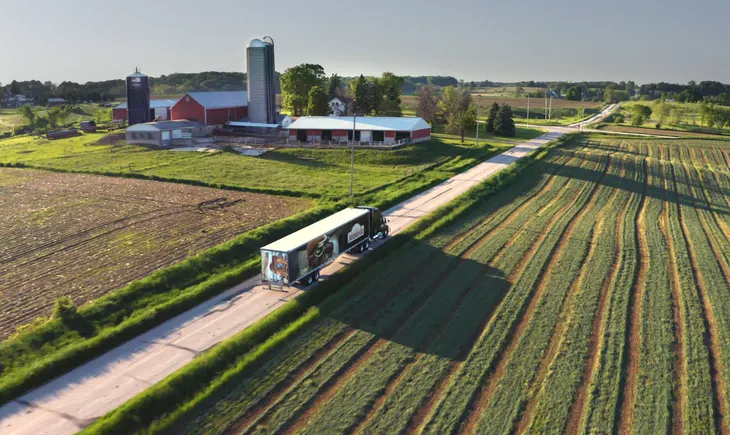
Roam Ranch co-founder Taylor Collins used to need just two weeks' notice to ship products from his Texas ranch to retail customers across the country. But in recent months, that timeline has stretched significantly.
Over the past few quarters, a surge in freight volumehas pushed up prices, leaving shippers facing a difficult trucking market. Manufacturing issues have compounded the problem, with shortages of tractors, trailers, and replacement parts.
"Freight rates are going up. That's the reality of the environment we're in right now," said Sarela Herrada, co-founder of Simpli, an ingredient company focused on vertical integration and ethical sourcing.
Spot rates for refrigerated trucks have surpassed $3 per mile, and contract rates have risen in tandem. Meanwhile, less-than-truckload (LTL) prices are above historical levels, and surging demand has ledsome carriers to refuse loads。
Truckload and LTL rates rise
It's not just prices and capacity putting pressure on the supply chain; reliability is also a concern. Appointment slots at distribution centers are hard to secure, and labor shortages are slowing loading and unloading at some warehouses.
"The main issue we're seeing in LTL is delays," said Justin Marx, CEO of Marx Imports, which brings in specialty and premium meats. "Trucks are often late."
Delays can risk spoilage and create a ripple effect—if a trailer isn't unloaded on time, the truck may be late for its next delivery. Worse, poor data and visibility into shipment status make it hard for shippers to know exactly how delayed things are.
Traceability is especially challenging in LTL, where freight may stop at multiple distribution centers and be transferred between trucks along the way.
"We know it's on the road," Collins said, "but we can't say exactly where it is. The trucking company can't either—they just know it's sitting in one of their warehouses waiting to be picked up."
Three strategies to mitigate the impact
For many ranchers and farmers like Collins, there's little viable alternative to trucking—either pay the high rates or don't ship.
While food suppliers and distributors can't avoid the trucking market, companies can still take steps to lessen the impact of market forces.
Shift to less congested regions
Limoneira, a citrus-focused agricultural company, said its CEO Harold Edwards on this month'searnings callthat the company "may lean toward shipping more product to East Coast markets and using trucking to move product west to avoid congestion."

This marks a shift for many companies that have historically relied on Southern California and New York, home to the nation's largest ports. Simpli's Herrada noted that traditionally, transit times from major ports were the shortest.
But now, bringing goods into ports like Baltimore and then trucking them to major port regions like New York can actually be faster.
"To actually get your goods, you have to look at the big picture," Herrada said.
Develop in-house logistics
Wisconsin-based Johnsonville Sausage plans to expand its private fleet to address capacity constraints.
It's not uncommon for large food producers, dairy companies, and grocers to run their own truck fleets, but it's typically not an area ranchers and farmers venture into.
"They're born to survive with what's available and minimize unnecessary equipment," said Curt Covington, senior director of institutional credit at AgAmerica.
Customer service is the top reason for owning a private fleet
Johnsonville's logistics director Curt Reynolds said the company will expand its private truck count from about 30 to 50-60 this year. Last year, the company also launched a new logistics business, opening up backhaul refrigerated capacity for other food and beverage manufacturers along its routes.
Owning trucks is an asset-intensive investment, and supply chain issues in parts and manufacturing make running a private fleet even harder. But volatility in the freight market has prompted Collins to bring some logistics in-house at Roam Ranch.
Collins said the company is investing in refrigerated and frozen trucks, building its own delivery team, and also handling some distribution in central Texas.
"This is a direction we never envisioned," Collins said, "but this is our home, and we want to have a very strong presence here. We can't rely on third parties to make that happen."
Communicate with suppliers and customers
As with any obstacle in the supply chain, shippers don't have to face challenges alone.
Johnsonville has worked with its grocery customers to walk through processes and understand pain points related to on-time, complete deliveries.
"What can we do as partners to solve the problem? Rather than pointing fingers with fines," Reynolds said.
"To actually get your goods, you have to look at the big picture."

Sarela Herrada
Co-founder of Simpli
Marx described his company's relationship with New Zealand's Silver Fern Farms, which supplies beef and venison. Over the years, the two have built a strong relationship, and Marx has always prioritized getting that farm's products to customers.
On the customer side, it's similar—when shipments are delayed and supply may be disrupted, earning the trust of restaurant buyers is crucial.
"This is one of the biggest solutions to the current supply chain crunch," Marx said. "You have to have a relationship mindset, not a transactional one."