
US West Coast Port Congestion Continues to Intensify, Full Truckload Spot Rates Remain High
After months of supply chain congestion, trucking routes in the Los Angeles area had shown signs of normalizing, with the number of vessels waiting outside the port falling from its February peak. However, the latest data shows no long-term decline in import volumes, and in the week of March 28, freight volumes in Los Angeles and Ontario re-entered DAT's top ten list. Port congestion, surging e-commerce demand, and a driver shortage are jointly pushing up spot rates, and analysts expect this trend to persist for three to four months.
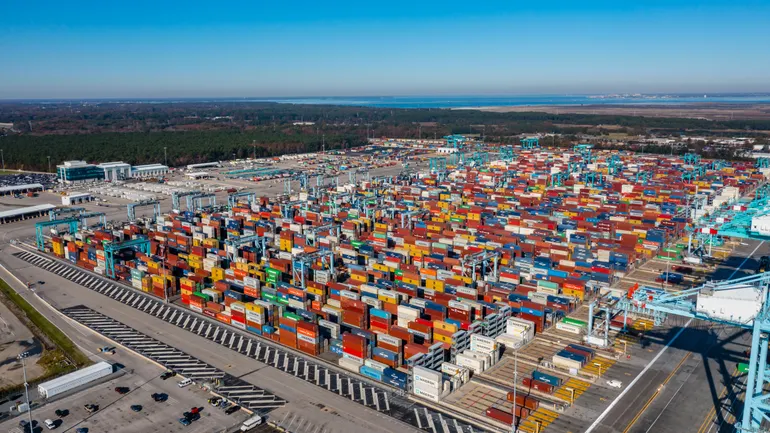
The so-called "normal" between 2020 and 2021 seems to be slowly returning to trucking routes in the Los Angeles area, after months of deep supply chain congestion in the region. The number of ships waiting outside the ports of Los Angeles and Long Beach in California fell in late March from its February peak.
According to DAT Chief Analyst Dean Croke, as draymen and dockworkers unload containers from ships and transfer them to trucks or trains for warehouse delivery, truckload (TL) spot rates have gradually declined. Croke said that for the week ending March 21, average TL spot rates out of Los Angeles or Ontario, California, fell 7 cents to $2.84 per mile.
"It looks like they have started to catch up," Croke said.
But the latest data shows no long-term signs of declining imports, foreshadowing a trucking market facing high rates and tight capacity.
For the week ending March 28, Los Angeles and Ontario re-entered DAT's top ten freight volume list, "with import volumes continuing to set records," Croke said. "After declining for most of March, outbound freight volumes from Los Angeles jumped 18% week-over-week, and Ontario grew 7%."
Croke noted that weekly port capacity was generally tight, with the degree of tightness depending on which outbound routes trucks used more frequently. For the week ending March 28, capacity in Los Angeles loosened, with rates falling 1 cent per mile to $2.81; Ontario tightened, with rates rising 2 cents per mile to $2.90.
More ships anchored waiting to berth
Complicating the port congestion situation was the "Ever Given" incident—the giant container ship ran aground in theSuez Canal on March 23, and was freed on Monday after being stranded for several days. Croke said that before the Ever Given was freed, it was too early to determine whether the ripple effects of the Suez Canal blockage would affect U.S. TL spot rates.
Croke said that California port congestion combined with surging e-commerce demand means U.S. retailers' efforts to replenish inventory could again extend into the summer and beyond. And the only way to replenish inventory is for shippers to enter the TL spot market, which could mean rates remain strong for weeks to come.
A far cry from the toilet paper crisis
A year ago, the trucking industry was racing against time to deliver toilet paper and other household goods to consumers. Panic buying in the early days of the U.S. COVID-19 pandemic caused TL spot rates to spike within weeks, then crash.
But U.S. inventories were at low levels in mid-2020. The pandemic, once seen as an economic killer, kept millions of people at home for most of 2020. People felt the need to renovate their houses or apartments and change their lifestyles, which drove more online shopping, further eroding inventory levels.
As shippers and retailers realized their warehouses were empty, spot rates began to climb slowly starting in May. E-commerce surged, and TL rates rose accordingly.
Now, with California ports congested, the driver of alleviating shortages is no longer toilet paper or personal protective equipment. What is stranded off the Golden State's coast isPeloton fitness equipment, sneakers,semiconductors, and petrochemical products—a mix of consumer and industrial goods demand that is likely to keep spot rates high and truckers busy.
Spot rates maintain momentum
As retailers and shippers replenish inventory, they will have to book trucks in the TL spot market to handle the wave of imports flooding into California ports—at a time when capacity is already tight and a driver shortage has long plagued the industry.
"This will keep capacity tight and spot rates high," Croke said. "I think this is a big deal for the trucking industry."
Croke said most of the cargo moving out of the ports is drayage or short-haul, with only a very small portion being long-haul. The number one outbound route is north to Stockton, California, accounting for 9% of DAT's national freight volume. He noted that Stockton has become a strong warehousing market due to its proximity to the ports. From Stockton, goods are distributed to the north, west, and east.
The current rate from Los Angeles to Stockton is $3.31 per mile. In February it was $3.09. A year ago it was $2.18.
Another major destination for port cargo is Dallas. Croke said the spot rate out of Los Angeles is $2.85 per mile, compared to $1.24 a year ago.
Rates rise on outbound routes from Los Angeles
But demand is mostly one-way. Croke said the rate from Stockton to Los Angeles is $1.36 per mile, down from $1.47 in February. Less freight is returning to the ports, partly due to declining U.S. exports and partly due to a globalcontainer shortage。
Even so, Croke said high outbound spot rates will persist for some time, as congestion continues to put upward pressure on rates.
"We could see this for the next three to four months," Croke said.
Big ports, big problems
Gene Seroka, executive director of the Port of Los Angeles, said at a public briefing on March 16 that the port had its busiest month in 114 years in February, with TEUs up 47% year-over-year, marking the seventh consecutive month of year-over-year growth.
"Consumer purchasing power has not weakened," Seroka said at the briefing. "The National Retail Federation forecasts that its members' sales in 2021 will grow 6.5% to 8.2% over 2020."
According to Ken Duncan, managing director of commercial operations at the Port of Long Beach, the ports of Long Beach and Los Angeles handle the largest share of imports from Asia, and Southern California has 2 billion square feet of transshipment space. The Port of Long Beach has six container terminals, and the Port of Los Angeles has seven.
"This will keep capacity tight and spot rates high."

Dean Croke
Chief Analyst at DAT
The demand for port services also means that stakeholders interacting with the ports, including trucking companies, will face bigger problems than those at smaller ports.
Duncan said that once container ships arrive at the port, unloading takes five to six days. East Coast ports do not experience such long unloading times because ships typically make multiple port calls.
Duncan said another familiar challenge—chassis management—caused problems early in the freight surge but has since eased.
Port terminals can accommodate a limited number of drayage trucks. According to Josh Brazil, vice president of ocean analytics at project44, ports have also been enforcing social distancing measures, which has slowed terminal operations.
"This has never happened before," Brazil said. "They don't have enough equipment to handle all of this."
When these two major ports "catch a cold," the supply chain can "cough." Delays accumulate. Croke said that when ships anchor outside the port and are delayed up to 21 days, intermodal agents miss their windows to move cargo. Croke said this forces shippers to turn to the TL spot market.
However, it is not the ports' day-to-day operational issues causing congestion and high spot rates. Croke pointed to surging imports, economic recovery, and the industry's perennial problem—the driver shortage—as combining to cause congestion and soaring rates.
Speaking of the driver shortage, Croke said capacity has not kept up with demand, especially at the ports.
Multiple problems converging at the two major ports have stunned analysts.
"We have almost never seen bottlenecks like this," said Tim Denoyer, senior analyst and vice president of trucking at ACT Research.