
Family-owned A. Duie Pyle celebrates centennial: Chairman reiterates commitment to independent operations
As regional less-than-truckload carrier A. Duie Pyle marks its 100th anniversary, Chairman and CEO Peter Latta said the company has rejected acquisition offers from several national competitors, remains family-owned and independently operated, and plans to invest in employees and technology to usher in the next century.
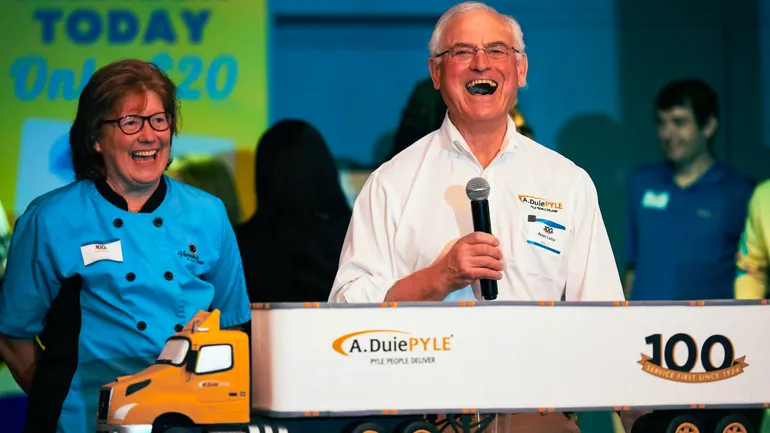
Over the past two years, Peter Latta, chairman and CEO of regional less-than-truckload carrier A. Duie Pyle, has rejected acquisition offers from two national competitors looking to expand into the Northeast market.
The West Chester, Pennsylvania-based carrier celebrated its centennial this year as a privately held family business, hosting a harbor cruise and other festivities for its 4,300 employees.
"We are absolutely committed to the people of Pyle and to operating as a family business," Latta said in an interview with Trucking Dive. "We've survived a tough 100 years, and now we have another tough 100 years ahead."
Pyle's expanding service area stretches from the border with Canada in Maine to the Virginia-North Carolina line, and west into West Virginia and Ohio. The carrier, which interlines with Dayton Freight Lines and Southeastern Freight Lines, generated $775 million in revenue last year.
Latta said the company started with two trucks and did not operate a single freight terminal until 1996. Over the past century, Pyle has survived labor unrest and other disruptions that felled competitors by fostering and maintaining a culture of trust between owners and employees.


Rebecca Oyler, president and CEO of the Pennsylvania Motor Truck Association, said Pyle's first customer, Lukens Steel, underscores Pyle's place in Pennsylvania trucking history. The state's history has seen trucking haul steel, coal, and food to support industrial and population growth.
"The history of our nation in the 20th century is intertwined with the history of trucking in Pennsylvania, and A. Duie Pyle should be proud to be a significant part of that history," Oyler said in an email.

"More than just a number or a body in a seat"
On a day in May, Jesse Weeks, hauling a 40-foot trailer loaded with paint, coffee, motorcycles, and other goods across the Baltimore area from a freight terminal in Jessup, Maryland, praised Pyle's approach to its employees.
The 48-year-old Pyle driver has 27 years of driving experience. He said he was the first driver hired when the company expanded into the Baltimore area. Now, he trains other drivers.
Executives call Weeks and his colleagues by their first names. They regularly visit terminals, share meals with drivers, and gather feedback.
"The bosses know you," Weeks said. "You're not just a number or a body in a seat."


Pyle's leadership reinforces this trust by informing employees about acquisition offers and the reasons for rejecting them.
"A common comment from many companies looking to acquire is, 'Nothing is going to change,'" Latta said. "But in reality, everything changes."
Latta noted that public companies—such as the two trucking giants that, along with private equity firms, unsuccessfully tried to acquire Pyle—depend on quarterly earnings results and analyst opinions for their survival.
"We don't want to live in a fishbowl," the chairman and CEO said. "We are very transparent with our employees—because we absolutely keep our promises."

"How did we survive?"
On April 1, 1924, Alexander Duie Pyle and Mary Ellen Pyle founded the company with a used 1918 International truck. Since then, the company has grown alongside its customers to become a leading regional carrier.
Over 100 years, the company has overcome numerous challenges, including the Great Depression, World War II, a 14-week strike, industry deregulation, a ransomware attack, the COVID-19 pandemic, and a roof collapse at a West Chester facility following a snowstorm.

"At the time, we had two warehouses, one freight terminal, and a team of fewer than 100 people. How did we survive when peers with markets, customers, and facilities did not?" Latta said. "I attribute it to a three-word answer: 'Pyle's people.'"
In 1979, Latta was deeply impressed by the close relationship between the company and its employees when he witnessed striking workers decide to leave the Teamsters union and end the strike.
"The Teamsters world back then was very different from today," Latta said. "They took a huge risk crossing the picket line and told the union, 'Enough is enough, we're done.' That gave me a deep understanding of trust and its power."
Jeff Young, a 62-year-old Pyle driver nicknamed "Squeak," said he felt that culture 30 years ago when he interviewed with Latta and his father, Jim Latta, who remained involved with the company after handing over the reins.
"As long as you work hard, tell the truth, and do a good job for us," Young recalled Jim Latta telling him, "you'll always have a job here."
Jessup terminal manager Jim Craig said that as CEO, Peter Latta is "a very good steward of the company" and has led it through growth.

Caring for "the ones who keep the wheels turning"
In addition to the harbor cruise and truck-themed cake, Pyle's centennial celebration included commissioning a model of the company's original 1918 International truck.
Pyle's employees were at the heart of the celebrations. After all, they were the ones who immediately began shoveling snow after the roof collapse and kept the company running during the June 2019 ransomware attack and the COVID-19 pandemic.
Weeks is looking forward to a gathering Pyle is hosting this fall at the National Aquarium in Baltimore for employees in the region.
He loves his job and feels that Pyle's leadership understands "we're the ones who keep the wheels turning," so "they make sure we're taken care of."
This freight job has allowed the driver to raise two sons in Mount Airy, Maryland—20-year-old Peyton and 17-year-old Trenton.
"This job has given my kids a good life," Weeks said. "Because I'm willing to go out and work, I can provide them with what they want and need."
Pyle believes that investment in employees and technology will be key to its future success. The company is integrating four terminals acquired from Yellow Corp., which filed for bankruptcy last year as it neared its centennial.
"Cultural engagement and employees going the extra mile—that's essential to seizing opportunities," Latta said.
Visual editor Shaun Lucas contributed to this story.