
Aurora: Operating cost of 85 cents per mile is attracting potential customer interest
Aurora Innovation CFO David Maday said on Wednesday's analyst call that the company's operating cost of 85 cents per mile is attracting carrier interest. As routes expand and commercial deployment progresses, autonomous driving technology inquiries have increased significantly over the past six months. The company expects to deploy over 200 autonomous trucks by year-end and achieve $80 million in revenue by the end of 2026.
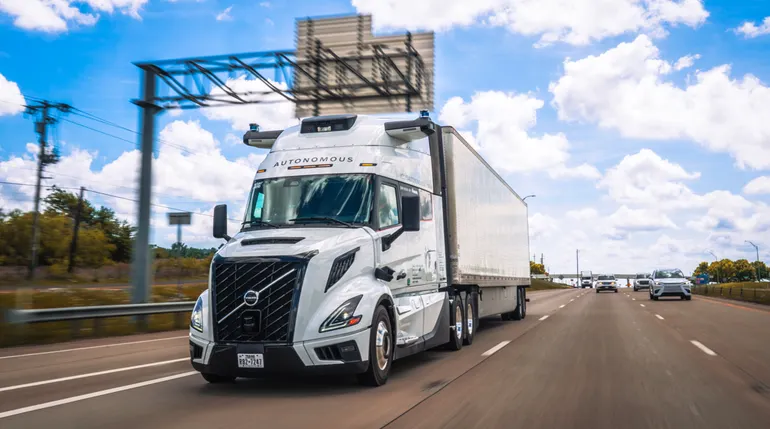
Key Takeaways:
- Aurora Innovation CFO David Maday said on Wednesday's analyst call that the company's ability to achieve an operating cost of 85 cents per mile is attracting carrier attention.
- Interest in its driverless technology has "risen significantly" over the past six months as the company expands routes and advances commercial deployment, Maday said.
- "Frankly, the volume of inquiries we're receiving is increasing dramatically," Maday said, adding that the company's expected pricing allows it to succeed and "support large-scale customer adoption."
Deep Dive:
Aurora told Trucking Dive it expects to deploy more than 200 driverless trucks (with no safety driver onboard) by the end of this year. Maday said this will translate to $80 million in revenue by the end of 2026.
An Aurora spokesperson said in an email to Trucking Dive that the company currently has 30 trucks serving its driverless routes. The spokesperson confirmed that routes validated for driverless operations include: Dallas to Houston, Fort Worth to El Paso, El Paso to Phoenix, Fort Worth to Phoenix, Fort Worth to Phoenix (duplicate in original), and Dallas to Laredo.
The company expects revenue growth to continue into 2027 and beyond, driven primarily by deepening existing partnerships.
A few days before its first-quarter earnings release, Aurora announced on April 30 an expanded partnership with Hirschbach Motor Lines. Under the agreement, the refrigerated carrier will own 500 driverless trucks operated by Aurora's technology.
On May 4, Aurora announced a new 200-mile route between Dallas and Oklahoma City with partner Volvo Autonomous Solutions. According to the announcement, through this collaboration, Volvo will autonomously transport goods to customer facilities, reducing the need for transfers and additional handoffs.
Then on May 6, Aurora announced a new autonomous route between Dallas and Houston with McLane Company, initially with an observer onboard. The agreement will expand by year-end to new routes between the food distributor's facilities across the U.S. Sun Belt.
Aurora and McLane launched a supervised autonomous pilot in Texas in 2023, which has since completed over 280,000 miles of autonomous driving, safely delivering more than 1,400 loads with a 100% on-time rate. According to the announcement, the pilot includes two round trips per day, seven days a week, between Dallas and Houston, using a hybrid model: Aurora's driverless technology handles the long-haul middle segment, while McLane drivers handle local deliveries to customer locations.
Maday said Aurora's growing public presence and commercial success are generating interest, adding that "part of it is that we're out there, and people can see and experience it more."
At the annual Raymond James institutional investors conference in March, Maday cited the American Transportation Research Institute's (ATRI) annual survey of truck operating costs. He said the 2025 report shows an average cost of about $2.26 per mile—with driver wages and benefits accounting for about $1 per mile—and noted that Aurora plans to price its operations at "about 85 cents per mile."
Maday said on Wednesday's analyst call that this is where Aurora's value proposition resonates.
"I think customers have been giving us very positive and direct feedback," he said. "We are confident we can achieve business growth and meet our profitability targets."