Back to Basics: The Full Circle of Roadrunner's LTL Business
After an accounting scandal in 2017, Roadrunner Transportation Systems returned to its roots by divesting non-core assets and focusing on long-haul truckload LTL operations. This article reviews its journey of acquisition expansion, financial restatement, and asset divestiture, and analyzes the prospects of the LTL market.
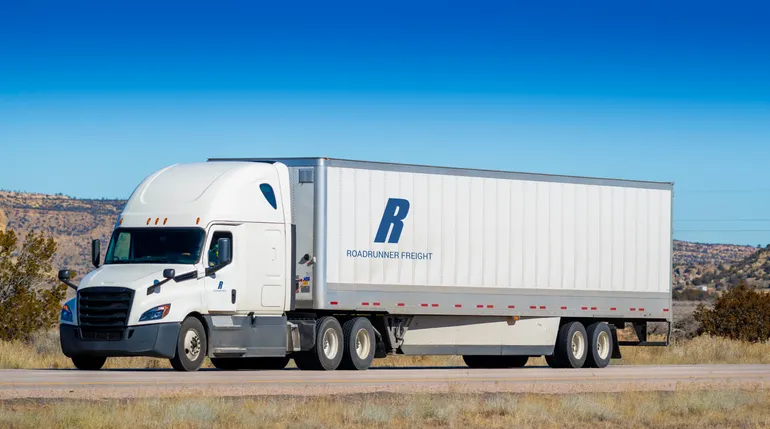
After the 2017 accounting scandal, Frank Hurst, committed to repairing Roadrunner Transportation Systems' reputation, was eager to understand customers' specific concerns and questions.
So, in January 2017, Hurst, who had just been appointed senior vice president and is now president of Roadrunner Freight, went to a service center in Akron, Ohio, put on headphones, and listened to customer calls. One major demand was shipment visibility.
"It was simple," Hurst recalled of those calls. "The calls I received were all: 'Did you pick up our shipment yesterday? Can you deliver it today? Can you give me a status update?'"
Hurst said these calls all came from rural areas where Roadrunner had no service centers, and the company relied on agents and partners to relay information to customers. Hurst realized that on these lanes, the company lacked the "information density" found on "linehaul" routes (routes to major cities or industrial areas).
This was just one of many problems Roadrunner had to solve in its new era.
"We truly lost our way."
— Frank Hurst, President of Roadrunner Freight
Roadrunner originally was a long-haul, intercity carrier focused on linehaul routes, serving less-than-truckload (LTL) shippers. Founded in the Milwaukee area in 1984, the company merged with another LTL carrier, Dawes Transport, in 2005, a deal facilitated by Thayer Capital Partners.
In 2010, after surviving the Great Recession and completing its IPO, the company went on an acquisition spree. Over the next several years, it acquired 25 privately held logistics companies. By 2016, Roadrunner was massive, ranking as the16th largest carrier in North America。
But Hurst said these acquisitions lacked strategy. The company, whose core was LTL, was no longer just LTL. It had an intermodal business and held several separate companies. The entire organization was bogged down by numerous branches. The LTL business had become just a division of Roadrunner, not its core.
"It wasn't just about service and quality," Hurst said. "We truly lost our way."
Roadrunner Acquisition and Divestiture Timeline
- 1984:Roadrunner Freight Systems is founded in Milwaukee.
- March 2005:Roadrunner merges with Dawes Transport to form Roadrunner Dawes Freight Systems.
- May 2010:Roadrunner raises $148 million in its IPO and lists on the New York Stock Exchange under the ticker RRTS.
- August 2011:Continuing its 2011 acquisition spree, Roadrunner acquires Prime Logistics for $98 million. Prime, an Indiana-based warehousing and distribution company, was the fourth acquisition up to that point in 2011.
- January 2017:Roadrunner says it will restate its 2014, 2015, and 2016 financial results after discovering accounting errors in two recent acquisitions, Morgan Southern and Bruenger.
- January 2018:Roadrunner completes its financial restatement. An internal investigation found that the company had overstated net income by $67 million from 2011 through the third quarter of 2016. Then-CEO Curt Stoelting blamed improper accounting by the former CEO and CFO during the acquisition of 25 private companies.
- April 2019:The U.S. Securities and Exchange Commission (SEC) charges former CFO Peter Armbruster and two Roadrunner associates with multiple accounting violations and fraud.
- November 2019:Roadrunner sells its intermodal business to Universal Logistics Holdings for $51 million.
- January 2020:Roadrunner sells Prime Distribution Services to C.H. Robinson for $225 million.
- March 2020:Roadrunner announces it will voluntarily delist from the NYSE.
- August 2020:Roadrunner completes its divestitures and announces it is a pure-play LTL company.
Root of the Problem
Size did not equal long-term success. The company had deep-seated problems that were not visible to the outside world. Like many public companies, it focused on quarterly income statements. In 2019, the company reported anet loss of $341 million. Hurst said driver turnover was a major issue. During a July 1 webinar with WorkHound, Brad Sowa, director of driver recruiting at Roadrunner Freight, said the company's driver turnover rate in 2019 was as high as140%。
Worse, according to former CEO Curt Stoelting's statements to analysts in 2018, the company had become increasingly complex, and its subsidiaries had inconsistent accounting policies.
That was after the January 2017 disclosure that it would restate its 2014-2016 financial results. Roadrunner said it found accounting errors in the Morgan Southern and Bruenger acquisitions. Stoelting, who was promoted to CEO in 2017 to turn the company around, disclosed that the company had overstated profits by $66.5 million from 2011 through the third quarter of 2016.
Three Roadrunner executives were implicated in committing fraud throughinflating assets and accounts receivable. In April 2019, the SEC charged former CFO Peter Armbruster and two associates with multiple accounting violations. Roadrunner voluntarily delisted from the NYSE in April 2020 and now trades over-the-counter.
As Roadrunner began fixing its problems and restating its financials, the company realized it had to break itself up and become a pure-play LTL company, Hurst said. The company had become too complex. Roadrunner began selling off parts of its business, such as the intermodal business and Prime Distribution Services, which had 2.6 million square feet of warehouse space.
After shedding size and complexity, Roadrunner also focused on an asset-light model. The company now owns no more than 30 tractors, relying primarily on owner-operators and independent contractors, Hurst said. At the same time, it expanded its service center network, announcing in July that it would add 169 dock doors at new terminals in Chicago, Philadelphia, and Riverside, California. Hurst said the company has 21 "physical" service centers, which are necessary to meet demanding LTL customers.
In terms of service, Hurst said the focus is returning to its traditional strength: LTL on linehaul routes of 1,500 miles or more. The company will focus on metropolitan areas, customer service, and new shipment visibility technology.
A Promising Niche
Roadrunner's new strategy will only work if it can secure enough LTL business to complete its transformation.
Large LTL company YRC Worldwide has similar hopes. Like Roadrunner, YRC also fell into an acquisition frenzy and neglected its core LTL business. YRC nearly collapsed,but in July it received a $700 million loan from the federal government under the CARES Act。
Months earlier, as panic buying subsided and the COVID-19 pandemic reshaped LTL and truckload demand, the industry questioned 2020 freight volume prospects. Now, analysts believe LTL will be well-positioned after the pandemic.
"LTL is much less fragmented than truckload," said Brian Thompson, chief commercial officer of SMC3. "The top 15 LTL carriers account for about 90% of the LTL market."
"LTL is a good business, it's a core business, and profit margins are slightly higher than truckload."
— Nikhil Sathe, Managing Director of Logisyn Advisors
LTL carriers can also capitalize on changes in market behavior during the pandemic. Shippers are using more warehouses that are farther from central hubs andcloser to consumer populations, said Steve Tam, vice president at ACT Research.
"E-commerce is decentralizing warehousing," Tam said. "As a result, truckload volumes are decreasing."
Tam said that at the end of the first quarter, 11.8% of retail sales, excluding food, were conducted via e-commerce. That number could be higher after the pandemic, meaning more LTL shipments.
LTL is also more attractive to investors and carriers. One reason is the increased use of last-mile delivery in consumer goods transportation, said Nikhil Sathe, managing director of Logisyn Advisors. The firm advised Roadrunner on its divestitures.
"LTL is a good business, it's a core business," Sathe said. "Profit margins are slightly higher than truckload."
A single trailer can carry four to five shipments, generating more revenue, Sathe said. Equipment utilization is therefore better than truckload, allowing carriers to achieve better optimization.
However, LTL requires more labor and investment than truckload, Thompson said. "Carriers need a network of physical terminals with dock doors, forklifts, and delivery trailers. Additionally, LTL carriers need more personnel to operate."
Hurst said Roadrunner is well aware of the labor needs and has hired additional drivers and terminal staff.
Back to Basics
Industrial customers are served by numerous LTL carriers, and when they don't need truckload, they can use the flexible services of LTL. But they demand reliable transportation, high-quality service, and shipment visibility, Hurst said. These are the customers Roadrunner has lost over the years.
Hurst said that as volumes grow and the company implements new processes to improve customer service, Roadrunner can win back many industrial customers. The addition of three "physical" service centers is part of that. Roadrunner has also installed dock automation to track shipments, Hurst said, and has reduced transit times on more than 500 lanes this year. As capacity tightens, industrial shippers will also try Roadrunner.
Roadrunner will also work to retain and attract drivers. Hurst said the company currently has about 850 drivers, including owner-operators and independent contractors. Turnover has decreased, and its reputation is recovering, having hired 100 drivers since January 1. Hurst said the company has the capacity to hire another 100 drivers.
The company's annualized turnover rate has dropped to 75%, and Roadrunner is collecting feedback through WorkHound. Roadrunner uses WorkHound'sanonymous feedback softwareand works to address the complaints or suggestions it receives.
"We didn't 'ship like we own it'... That was the fundamental problem we had to change."
— Frank Hurst, President of Roadrunner Freight
More candor is also part of the new policy, as Hurst is frank about the lessons Roadrunner has learned since early 2017.
"We didn't 'ship like we own it,'" Hurst repeated the company's slogan. "We admit that... That was the fundamental problem we had to change. In 2017, we began to truly change the organizational structure, leadership, and processes."
Hurst said Roadrunner started with a simple, easy-to-communicate goal.
"Customers entrust their freight to us," Hurst said. "They trust us. It's our responsibility to ensure pallets arrive on time, in good condition, and undamaged at their destination."