
Old Dominion Drives LTL Growth with Service Hub Strategy
Old Dominion Freight Line is evaluating and expanding its service hub network using the "door pressure" metric to address e-commerce-driven LTL demand. The company recently added nine new hubs but faces challenges such as land scarcity, zoning approvals, and rising costs. Despite competitive pressures, the company insists on not reducing services, and its operating ratio continues to lead the industry.
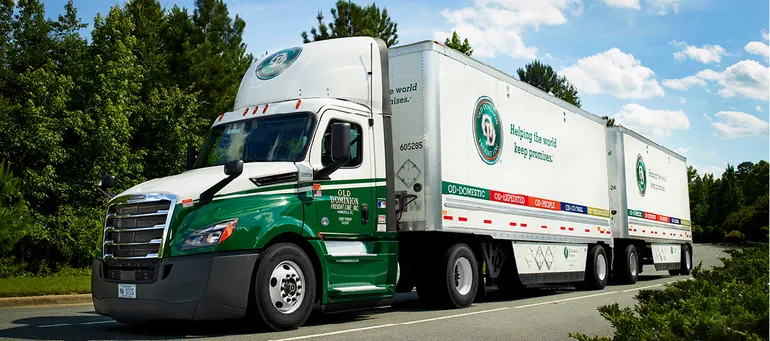
The less-than-truckload (LTL) industry is being driven so strongly by e-commerce and consumers staying home that Old Dominion Freight Line feels the pressure at the doors of its service centers.
It's a real pressure, and not necessarily a bad one. Dave Bates, Old Dominion's senior vice president of operations, said the company uses a "door pressure report" to check how often loading doors are used daily and the volume of freight processed through service centers.
Excessive volume and door pressure (measured by higher numbers per door) can clog operations. Bates noted that simply adding more people doesn't help, because that leads to workers and forklifts colliding with each other.
When Old Dominion sees door pressure starting to rise, it realizes it's time to add capacity. Company officials say door pressure is a primary indicator for evaluating whether to expand or build new service centers.
"You have to have a smooth dock operation," Bates said, comparing an overly busy service center to the crowded scene at Walmart on "Black Friday." "Once volume exceeds capacity, efficiency starts to slip away."
These efficiency losses can also lead to linehaul drivers being delayed at loading docks, as well as delivery delays from the hub to the consignee.
To avoid too much freight flowing into overloaded service centers, Old Dominion announced it would open nine new hubs. These hubs are located in Brooklyn, New York; Edinburgh, Indiana; Grand Island, Nebraska; Louisville, Kentucky; Mansfield, Ohio; McDonough, Georgia; Mesa, Arizona; Milton, Pennsylvania; and Olympia, Washington.
The company currently has 246 hubs (including the nine mentioned), all of which are operational. This number is up from 117 in 2002. However, challenges remain as Old Dominion continues to expand while maintaining the industry's best LTL operating ratio.
One challenge is acquiring the land needed to build new hubs. Another is obtaining government zoning approvals, a lengthy process. On the business side, Old Dominion sees more e-commerce users demanding faster freight speeds, quicker customer service, and faster delivery.
Old Dominion adds nine service centers
Land, as my father would say
When planning to add more service centers, Old Dominion faces land availability issues. Service center locations must be relatively close to the population centers that Old Dominion and its customers serve.
The higher the land price, the higher the cost. Old Dominion set a capital expenditure budget of $245 million for real estate in 2021, covering purchasing property, building, renovating, or expanding its service center network.
The size of each service center varies by market. Old Dominion custom-builds each facility based on market demand and with an eye toward future growth. Sizes range from 15,000 square feet to over 300,000 square feet.
But according to Old Dominion, the industry's best measure isn't square footage—it's doors. Each of the nine new facilities has between 30 and 105 doors.
"We try to buy land and space with future expansion in mind, so our lots are typically between 10 and 20 acres," Bates said.
Buying land and getting approvals is a tough task. Other strategies, like purchasing leased facilities, can be too costly. Bates mentioned that Old Dominion once asked a landlord in New Jersey if they would sell a building; the asking price was $80 million, and the company ultimately walked away.
Sometimes land can be found, but then another problem arises: many jurisdictions classify freight as heavy industry. As a result, many of the sites Old Dominion examines require rezoning. Planned buildings also draw resistance from municipalities.
This is also an issue CEO Greg Gantt discussed with Transport Dive in December. Gantt said that in the past, Old Dominion could take over surplus properties sold by other carriers, but that strategy is fading because few such buildings remain.
"Over time, all of a sudden, they're gone," Gantt said.
"Freight isn't an industry everyone wants to bring to their town."

Dave Bates
Senior Vice President of Operations at Old Dominion
Bates said states with more land and fewer regulations tend to welcome Old Dominion and open their doors to its new developments.
"If we want to build a large service center in West Virginia, they'll welcome us with open arms," Bates said. "But in New York, New Jersey, California—it's much harder."
Old Dominion wants to operate everywhere. But company officials say that in densely populated areas like New York, New Jersey, and California, it's difficult to find suitable facilities due to premium real estate prices and proximity to population centers.
Most municipalities try to accommodate businesses with commercially zoned parcels. Old Dominion has even faced resistance from some industrial parks because light industrial companies don't want to be near service centers.
"Freight isn't glamorous," Bates said. "Freight isn't an industry everyone wants to bring to their town." (Unless, he noted, their shipments are delayed.)
Land issues have prompted Old Dominion to "turn over every stone" when selecting sites. For example, in the Indianapolis area, that means expanding on both ends, but outside the state capital's borders. Old Dominion placed a service center in Lafayette, Indiana (along I-65 north of the city), and another in Edinburgh, Indiana (along I-65 south of the city).

E-commerce creates pressure
Bates said e-commerce is part of the reason for the need for more service centers.
As people live and work from home, inventory must be closer to where people live, and consumers are emptying shelves at a faster pace.
Peter Stefanovich, managing partner at Left Lane Associates, noted that retailers and warehouses used to be satisfied with a week's worth of demand; now they want two to three weeks of product on hand.
He said Old Dominion's expansion of service centers helps the company shorten delivery times.
"The key is having a network that lets you reach the end user faster," Stefanovich said.
Stefanovich said the "Amazon-ization" of the economy and consumer demand have created a more urgent need for efficient, fast delivery.
"Our psychology has changed, expecting things to happen faster," Stefanovich said.
Commitment to service
As freight demand increases, costs rise as well. On Monday, Old Dominion announced a 4.9% general rate increase (GRI) effective March 1.
"To meet customer expectations and fulfill our promises, we must continuously enhance our high-quality service network and systems," Todd Polen, Old Dominion's vice president of pricing services, said in reference to the rate increase, adding that part of the GRI will offset rising real estate costs.
Despite expansion challenges, analysts seem confident in Old Dominion. David Ross, managing director of global transportation and logistics at Stifel, wrote in a February 4 report that Old Dominion is again the leader in LTL industry operating ratio.
"Just as the sun rises every day, we believe it's now safe to say Old Dominion will report the best margins in the LTL industry every quarter," Ross and his team wrote in the report.
Old Dominion's operating ratio improves
Stifel noted that Old Dominion hasn't always had such an excellent ratio, or as many service centers as it does in 2021.
"When we began covering the stock, the company's operating ratio in Q3 2002 was 91.9%, compared to 76.3% in Q4 2020, and its geographic coverage was much smaller (117 service centers in 2002 versus 245 today and growing)," Ross wrote.
Ross said the efficiency gains puzzle investors in a positive way.
"The number one question we get from investors about Old Dominion is, 'Why are its margins so much higher than peers?'... or 'What's the secret?' or 'How do they do it?'" Ross wrote.
Gantt answered that question in December, sharing a lesson the LTL carrier learned during the Great Recession of 2007-2009:
"We've been very consistent, even going back to the recession in 2009," Gantt said. "We didn't cut service."
"Just as the sun rises every day, we believe it's now safe to say Old Dominion will report the best margins in the LTL industry every quarter."
David Ross
Managing Director of Global Transportation and Logistics at Stifel
When the pandemic hit, the temptation to cut prices and service was real. Its LTL competitors lowered prices, and customers noticed.
"Early on, we did lose some business over price," Gantt said. "All of a sudden, everyone had excess capacity."
But Gantt said customers noticed that some non-price factors were missing—such as on-time delivery, customer service quality, and cargo care. Old Dominion says its LTL on-time service rate is 99%, and it has maintained that for several years.
Eventually, the lost customers came back.
Bates said the service center plan means maintaining high-quality service and not letting freight linger too long in hubs.
"Ideally, we pick it up today and ship it out tonight," Bates said. "We want freight to be delivered the day it arrives or the next day."