
The Role of the Trucking Industry in Solving the Congestion Crisis at US West Coast Ports
Severe congestion at the ports of Los Angeles and Long Beach has prompted stakeholders across the supply chain to explore its root causes. Although high hopes are placed on the trucking industry, industry experts point out that the crux of the congestion does not solely stem from trucking capacity; the accumulation of empty containers, terminal operational efficiency, and intermodal coordination are the key factors. This article reviews various perspectives and recent response measures.
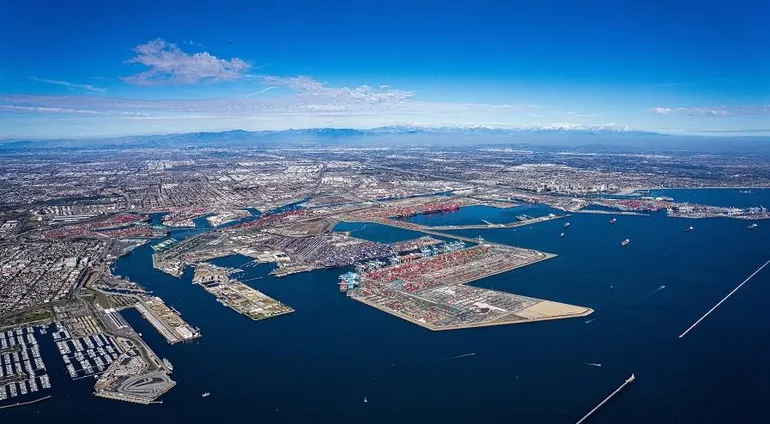
The ports of Los Angeles and Long Beach in California are experiencing historic congestion, and all parties in the supply chain are exploring the root causes of the bottleneck. However, there is still disagreement within the industry over the causes of the congestion at the San Pedro Bay port complex.
Ports and trucking fleets have long been plagued by trailer and container issues. Chassis and dry vans are scattered across the country, with some vehicles waiting far longer than normal to unload and return to ports or warehouses. The situation is so severe that some carriers have begun charging customers detention fees for trailers held up.
"I've never seen anything like this," said Brent Hutto, chief relationship officer at Truckstop.com. The freight matching platform posts about one million loads daily.
Trucking experts believe the industry can help alleviate the situation at California ports, but they also point out that trucking is not the main cause of the problem, nor even the primary party responsible.
The core of the congestion
The global supply chain has been operating at overcapacity for more than a year, and speculation about the causes and solutions has been rampant both inside and outside the industry.
Matt Schrap, CEO of the Harbor Trucking Association, said the shortage of long-haul truck drivers is often seen by outsiders as a breakthrough point for solving port congestion. He noted in a LinkedIn post on October 28,This is not an effective solution for the port. He told Transport Dive that adding drivers would not help the ports at all. In fact, there is no driver shortage at the ports, and chassis are not the main obstacle for port carriers.
Schrap observed that carriers are being forced to send drivers home because they cannot get appointments to return empty containers to release chassis. In this situation, more drivers would only worsen the congestion.
"There is no driver shortage at the ports," Schrap said. The nationwide long-haul driver shortage is a "scapegoat" and a "misleading narrative."
"Empty containers are the core of the problem... they are strangling carrier yards," Schrap emphasized.
Schrap noted that some might think carriers need chassis, but many chassis are being occupied by empty containers, effectively used as storage devices.
"This is not necessarily a trucking problem," Hutto said, "but rather the inefficiency of the terminal yards themselves."
According to Gene Seroka, executive director of the Port of Los Angeles, during amedia briefingon November 16, about65,000 empty containerswere stranded at the port's terminals last week. This left terminals with almost no open space for trucks to return empty containers until vessels could load them and ship them back across the Pacific.
"It's all about efficiency," Schrap said. "I can't stress that enough."
RPT 11/19: 159 total ships inport LA/LB incl. 95 at anchor or loitering & 64 at berths. Of the 159, 101 are container ships incl. 71 at anchor or loitering & 30 at berth. 46 vessels loitering; 36 container ships, 4 tankers, 3 bulk, 3 general cargo.
— Marine Exchange (@MXSOCAL) November 19, 2021
More: https://t.co/5aY5tXPsjq pic.twitter.com/Euy1YYh0CX
Hutto believes that terminal yards are understaffed, causing delays in unloading cargo and transferring it to trucks or trains. Seroka disputed this claim.
"We haveplenty of dockworkersto do the job," Seroka said in October. Since March 2020, International Longshore and Warehouse Union (ILWU) workers have averaged six days of work per week. Additionally, the union has expanded its workforce in recent months and strengthened training programs.
So, how can the trucking industry help unclog the ports? The answer may be that trucking can only contribute partially, as it is just one link in the entire supply chain.
Intermodal stakeholders discuss solutions together
On October 26, Chris Spear, president and CEO of the American Trucking Associations (ATA), told the media at the Management Conference & Exhibition in Nashville that the trucking industry would work with other modes of transportation, such as rail and ocean, to propose recommendations for alleviating port and other supply chain bottlenecks.
"In certain areas, container stacking could temporarily be increased from two tiers to four tiers," Spear said. "This would help free up yard space. With yard space, the flow of empty and loaded containers would improve significantly. Right now, everyone is running out of space."
The Port of Long Beach has recently allowed four-tier stacking, but Schrap noted that companies must have the appropriate stacking equipment, which creates another logistical challenge.
"With yard space, the flow of empty and loaded containers would improve significantly. Right now, everyone is running out of space."

Chris Spear
President and CEO of the American Trucking Associations
Hutto believes local governments should play a larger role. The ports are governed by the cities of Long Beach and Los Angeles. Both cities and the state of California are actively investigating the bottlenecks.
On Wednesday (November 17), California Governor Gavin Newsom acknowledged the progress made at the ports and announced regulatory waivers to speed up the movement of trucks out of the two mega-ports.
One measure is extending hours at some Department of Motor Vehicles (DMV) offices to ease labor constraints in the truck driver market. Newsom said at the Port of Long Beach that this would nearly double the number of monthly CDL (commercial driver's license) tests from 5,000 to 9,700.
Another measure isrelaxing weight limits, raising the weight limit on state highways and interstates between the ports of Los Angeles and Long Beach and inland California distribution centers from 80,000 pounds to 88,000 pounds.
Schrap is skeptical about the effectiveness of the higher weight limit. Many containers arriving at the ports are filled with lightweight retail goods, such as footwear. HTA members are not currently rushing to apply to Caltrans for permits to haul heavier loads.
At LA and Long Beach ports today talking about how we can alleviate supply chain issues.
— Gavin Newsom (@GavinNewsom) November 17, 2021
Good news -- we’ve seen a 32% DROP over 2 weeks for containers sitting on docks.
Today, CA’s issuing a temporary truck weight exemption on our highways to keep goods moving efficiently.
Schrap said his association's members have taken their own measures to address the empty container issue. Trucking companies have leased lots outside the ports, even as far away as Arizona, "wherever they can find space," Schrap said.
But off-site storage solutions also have problems. Schrap cited a survey showing that his members have at least 9,438 empty containers backlogged, of which 8,117 are still on chassis. If fleets use chassis to store empty containers, they cannot be used for unloading operations.
Schrap hopes to see two things: first, "sweeper vessels"—ocean carriers dedicated to returning empty containers to Asia; and second, more officially recognized empty container depots—acknowledged by depot operators, ocean carriers, and equipment providers—with no additional fees at such depots.
Hutto said change will not come quickly, as government agencies are like large ships that turn slowly. Spear is also not optimistic about a short-term miracle before the holidays.
"The problem won't be solved before Christmas," Spear said. "Working with other modes of transportation and policymakers to understand the nature of the problem is the fastest way to solve it."