
Fleet technology upgrades are accelerating, but the widespread adoption of electric garbage trucks still awaits its time
Over the past year, local government budgets have been strained by the pandemic, forcing some waste collection services to adjust. Despite this, some businesses and governments are still considering investing in new technologies to improve collection efficiency and reduce environmental impact, with electric trucks being one of the most capital-intensive areas. Cities such as Baltimore have begun adopting route optimization software, while the popularization of electric garbage trucks remains constrained by factors such as cost and infrastructure.
Over the past year,local government budgetshave come under unprecedented pressure due to the pandemic. Some hauling companies and municipal departments have had to temporarily adjust their service offerings.
Despite this, some businesses and governments are still weighing investments in new customizable technologies aimed at making collection safer and more efficient while reducing fleets' environmental impact—one of the most talked-about and capital-intensive areas being electric trucks.
Take Baltimore, for example, which just restarted citywide curbside recycling service after a hiatus of more than four months, with the pandemic serving as the catalyst for its procurement of Rubicon's logistics software. John Chalmers, head of the Bureau of Solid Waste at Baltimore's Department of Public Works, said thenearly $792,000 emergency contractwill give the city access to a turn-by-turn route optimization product for one year. Rubicon has sold the software to more than 55 cities since 2017, and according to the company, they had been in talks with Baltimore before the pandemic.
However, increased worker absences due to illness or quarantine have highlighted the difficulty crews face in executing routine routes when managers or experienced drivers are absent. Baltimore believes digital routing can change that. Chalmers said, "When a new driver comes on board, he's able to get up to speed quickly." The product suite is also used to track missed pickups, which is especially critical when people are generating more trash at home.
Conor Riffle, vice president of Rubicon's Smart Cities division, said, "The pandemic really accelerated the conversation. We started having serious discussions about how to help them address the challenges brought on by the pandemic." Beyond the Baltimore contract, "overall, the pandemic has increased the adoption rate of our technology." Chalmers ultimately said the city is interested in exploring other fleet and collection technologies, but it will depend on budget.

Pressure for Change
Although the pandemic is widespread, compared to other regulatory and economic factors, it is only a temporary force driving change. Industry players and observers believe these factors will support the adoption of new fleet and collection technologies. Route optimization may be easier to achieve in improving truck efficiency and reducing emissions, but the vehicles themselves will eventually change as well.
Baltimore's2019 Sustainability Planset a goal to reduce citywide greenhouse gas emissions by 30% from 2007 levels by 2023. On the other coast, Los Angeles has committed to a zero-emission fleet by 2035, whileCaliforniamandates that all new car sales be electric by that same year. Additionally, Washington, D.C., is working with 15 states to ensure that 30% of new medium- and heavy-duty vehicles are zero-emission by 2030 (with a target of 100% by 2050).
New York City is testing partial and fully electric solutions in its fleet of more than 6,000 sanitation vehicles. Meanwhile, Canadian hybrid technology company Effenco has retrofitted 12 trucks to reduce idling engine use and plans to retrofit 14 more. Effenco President David Arsenault believes the disruption from the pandemic is a catalyst for change: "The waste industry is a relatively conservative industry. Many of our customers see how such a tiny virus has had a huge impact on everyone's lives, and now they're really thinking: what about climate change?"
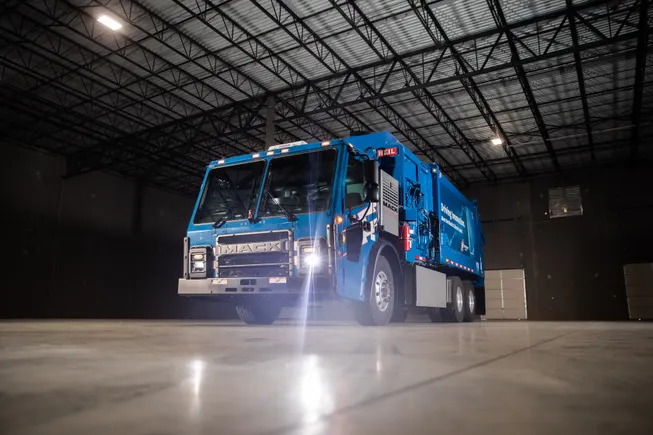
Additionally, Mack Trucks says it currently holds the largest share of the DSNY fleet and delivered an electric demonstration model to the department last fall.
While some cities are slower to adopt electrification, the more capital-rich private sector is being driven by investor environmental pressure. Over the past few years, all publicly traded companies in the industry have set or committed to setting greenhouse gas reduction targets as part of their environmental, social, and governance goals. The nature of these reduction targets varies by company, but regardless of timing or quantification, all are moving in the same direction and may achieve these goals through partial fleet electrification or other new technology investments.
The Electrification Outlook
Among the large companies, Republic Services has been the most aggressive in embracing the electric future. President Jon Vander Ark last year called the company "long-term bullish on electrification." However, Republic's industry-leading agreement with Nikola (up to 5,000 electric garbage trucks) was terminated last December, with both sides citing "development timelines exceeding expectations, as well as unexpected costs."
Republic says it remains committed to advancing electric options. Mack is one of its partners, and the two plan to test a jointly developed product early next year. Republic is also a major investor in Romeo Power (whose chief operating officer is aboardmember), a California-based public company that develops lithium-ion battery modules and packs for commercial electric vehicles. After terminating the partnership with Nikola, Republic said in a statement: "We look forward to working with all OEM partners to leverage innovative technology," adding that it "plans to make additional purchases from various suppliers in 2021." Republic did not arrange for a representative to discuss the matter further.
Noah Kaye, senior research analyst at Oppenheimer & Co., said, "You're seeing increasing competition, which is healthy, and I think it helps with quality." Kaye mentioned existing industry partners like Mack, Peterbilt, and Lion all making strides in the electric space, but he believes the competition is still open for suppliers of all sizes, provided they can meet important conditions and support a strong supply chain. "Waste companies should not be excluded from partnering with new market entrants."
One company looking to seize the opportunity is electric powertrain developer Wrightspeed, another California fleet technology company. Chairman Kevin Landis said, "It's safe to say that everyone is talking to everyone right now," noting interest from potential partners. Landis believes that more influential than government- or investor-driven climate action is the declining cost of electric technology. "This is more about economics than politics," Landis said. "The public conversation is encouraging, and it provides a source of pressure. But if the economics don't work, fleet operators will only do the minimum to get by."

Although Wrightspeed has previously tested its powertrain in the waste industry, there are currently no active pilot projects. The company has undergone several leadership changes in recent years, including the departure of founder Ian Wright (a co-founder of Tesla). According to the company's own analysis, its diesel range-extended electric powertrain can save more than $16,000 per year in fuel economy compared to heavy-duty residential garbage trucks. Like other companies marketing collection technologies, Wrightspeed emphasizes customization, offering mid-life retrofits or brand-new electric truck options.
But according to company data, Wrightspeed'scompressed natural gasoption still shows the lowest total cost of ownership. CNG is sometimes called a "bridge technology," with less significant emission reductions than electric, but it remains a favored approach for companies like Waste Management.
Another industry observer believes that despite the pandemic's negative impact on local budgets, cities always face funding constraints when considering large-scale electrification transitions. Camron Gorguinpour, director of sustainability and energy consulting at Engie Impact, said in an email: "Many companies and municipalities are expected to 'wait and see' the benefits of early adopters before deciding whether to purchase electric vehicles. Overall, uncertainty around EV infrastructure, the range needed for organizational fleets, and vehicle costs will be determining factors in the long-term success of the technology."
To a large extent, many large companies have so far lacked strong commitments. Several executives have said electric trucks will be very important in the future, but quickly pointed out near-term obstacles. Ned Coletta, chief financial officer of Casella Waste Systems, said, "This is an area where I think early movers face complexity." He cited the lack of existing infrastructure and said electric technology is costly and still in early development stages. "There are other things that can be done right now," Coletta added, mentioning route optimization technology andautomated side-loadingtrucks, which can address some efficiency and greenhouse gas emission issues in the short term.
Waste Connections is testing a hybrid truck with a diesel chassis and a fully electric body. Jim Little, executive vice president of engineering and disposal, said, "We know that going from testing to mass production of these vehicles will be a long process. So in the meantime, we still believe RNG and CNG have a long way to go... So we're looking at both ends—long-term in the electric space and what these vehicles can do for us, and short-term building out our RNG capacity."
Meanwhile, compared to other major competitors, Waste Management's collection fleet is the most reliant on CNG (over 70% of its collection fleet used CNG before the completion of its acquisition of Advanced Disposal Services at the end of 2020), and it intends to continue using it for some time. Waste Management did not specify the current percentage of CNG trucks since integrating ADS. Chief Financial Officer Devina Rankin cited cost and battery weight as "factors that limit us from viewing it as a near-term solution." But Rankin said the company's fleet strategy will gradually evolve as electric vehicles become "part of a more realistic and viable solution."

Adoption During the Pandemic
Despite hesitation on electrification, the industry is adopting many other technologies more smoothly. Waste and recycling software provider AMCS saw hesitation among potential customers and a decline in new sales during the pandemic, but according to Lasse Jiborn, commercial director of smart optimization, the company received more requests for route redesigns as the pandemic shifted the ratio of residential and municipal waste to commercial and industrial waste. Jiborn said the need for route optimization "has always been there," but many customers "didn't really feel the urgency until the pandemic." It is other trends that have developed over the years (including declining costs of connected devices) that have enabled these transitions to be implemented relatively smoothly for customers.
Similar to Rubicon's successful pitch in Baltimore, other collection technology experts believe current cost constraints are precisely the reason to start using new tools they claim can pay for themselves. San Diego-based Lytx, a self-described video telematics expert that has been operating for over two decades, partially sells 360-degree dash cameras to fleets to promote safety and accountability. When product management director Kristin Costas joined Lytx about nine years ago, much of the effort was spent getting customers to accept the idea of in-cab cameras. Costas said, "Collisions are very expensive, especially in the waste industry." Identifying and eliminating even "a small fraction" of risky behaviors "really pays for our technology immediately."
Over the past five years or so, Costas believes cameras have become ubiquitous. Waste Connections says it recently spent $10 million to replace older camera models, primarily through Lytx, but also deployed cameras from 3rd Eye of Katy, Texas, "in markets where the product fits best," according to email comments from Joe Box, finance director at Waste Connections. He said, "Overall, we're very excited about new technology, which should help drive the next phase of safety improvements." Despite the proliferation of cameras in recent years, garbage and recycling collectionremains one of the deadliest occupations in the U.S.。
Lytx's marketing is still safety-led, but has evolved to focus on the potential downstream economic benefits of safe driving, including reduced fuel consumption and vehicle wear and tear, Costas said. The company has also ventured into container tracking, while San Francisco-based Compology has made that its primary business. Compology focuses on using cameras to track contamination in containers and how quickly they fill up, allowing businesses to "adjust" collection schedules. The idea is that reducing collection frequency can save customers money and reduce unnecessary miles driven, thereby reducing emissions. According to data Compology collected from approximately 162,000 cameras, the average commercial container in the U.S. is only 46% full when emptied. "Now more than ever, this needs to be corrected," said Jason Gates, CEO of Compology.
Compology also sees opportunities to expand its services into the new need to track, calculate, and report progress on ESG goals. In the long term, the company hopes to establish connections with back-end systems and potentially serve as a hub between waste generators, haulers, and city or state governments, "which are all looking for the same information, but for different reasons." Overall, Gates believes the businesses that benefit most from these tools are those that can integrate them early, whether it's container monitoring, in-cab route technology, or customer interaction through chatbots. As haulers seek help during turbulent times and anticipate future challenges, more companies are building the business case for initial investments. Gates said, "Often, the companies that get the best returns from technology are those that can design their business around actually using it from day one."