
Aurora Innovation enters commercialization scaling phase, second-generation autonomous driving hardware costs halved
Aurora Innovation announced in its Q2 2026 earnings call that its second-generation autonomous driving system will drive hardware costs down by over 50%, and plans to achieve an annual production capacity of 1,000 trucks by October. The company expects 2026 revenue of $14 million to $16 million, and if all trucks are operational, annual revenue could reach $80 million.
At a Glance
- Aurora Innovation executives said during a July 29 analyst call that the company is entering a phase of commercial scale-up, with its second-generation trucks featuring improved autonomous driving technology performance and hardware costs cut in half.
- Co-founder and CEO Chris Urmson said on the call, "The key point is that we expect this kit to reduce the hardware cost of the Aurora Driver by more than 50%, which is a critical lever in supporting our goal of achieving gross margin breakeven."
- Urmson said 20 to 25 autonomous trucks are expected to be in operation in the third quarter. Manufacturing partner Roush is on track to reach a production rate of 1,000 trucks per year by October.
In-Depth Analysis
As Aurora Innovation advances toward scaled production, CFO David Maday said on the call that more than 200 driverless trucks will be in operation by the end of 2026. Ultimately, if all trucks are operational, Aurora could generate $80 million in annual revenue through Transportation-as-a-Service (TaaS) agreements. Since not all trucks will be operational this year, Aurora expects 2026 revenue to be between $14 million and $16 million, consistent with its shareholder letter forecast.
TD Cowen analysts view the additional TaaS agreements as a positive signal for the autonomous trucking industry. They wrote in an investor note, "New customer TaaS orders help accelerate the commercial flywheel effect and indicate strong market demand for autonomous trucking solutions." The analysts also noted that Aurora executives said existing TaaS customers plan to transition to more profitable 'Driving-as-a-Service' (DaaS) agreements in 2027.
According to Aurora, through DaaS agreements similar to the one it reached with Hirschbach, customers can own and control assets, thereby maximizing total cost of ownership savings. Although Aurora does not own these vehicles, the company will generate revenue through Aurora Driver subscriptions, gradually transitioning to a high-margin, capital-efficient business model, as outlined in a May press release.
TD Cowen analysts added that recent partnerships announced with Charger Logistics and Value Truck "not only validate Aurora's technology but also indicate growing industry confidence in autonomous trucking solutions."
Aurora said in its shareholder letter that to support accelerating customer demand, the company is advancing hardware and autonomous truck programs. Technological improvements include enhanced performance, more efficient computers, and improved long-range lidar, which together provide reaction times exceeding 34 seconds at highway speeds.
Urmson emphasized on the call, "It's crucial to understand the rigorous testing we conduct to bring these systems to the expected durability. We have been testing these units for months and will continue to do so to build ongoing confidence in them."
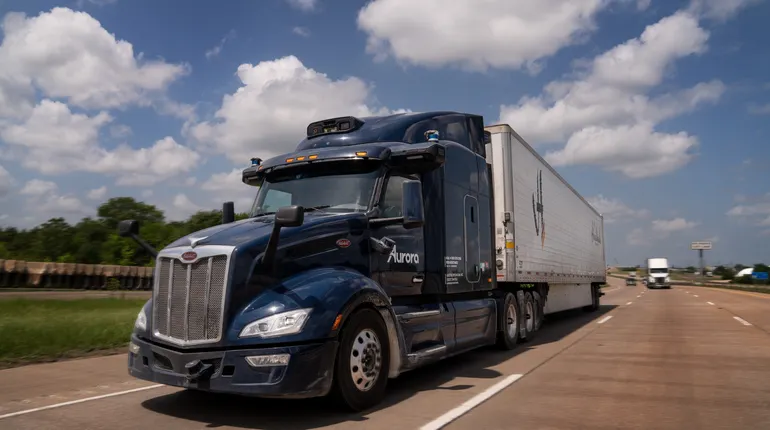
Urmson said the company's first-generation technology installed on Peterbilt trucks will be phased out. Aurora's new technology will be applied to International trucks and vehicles produced and used by Volvo Autonomous Solutions. Volvo also announced expansion plans and intends to remove safety drivers in the first quarter of 2027 to achieve fully driverless operations.
Urmson said continuous technology evolution is part of Aurora's strategy. He said, "We have already begun reliability testing on third-generation hardware components. This work is ongoing and gives us confidence in the future performance of our fleet."
Note: This article has been updated to clarify Aurora's expected revenue in 2026 and potential changes once all trucks are operational in the future.