
Multiple Parties Join Forces to Build California's 'Green Truck Corridor'
The Port of Long Beach, The Wonderful Co., and Lincoln Transportation Services signed a memorandum of understanding to plan the development of an approximately 150-mile-long 'Green Truck Corridor' connecting Long Beach, California, with the Central Valley, to coordinate freight movement, promote zero-emission trucks, and improve air quality.
News Summary
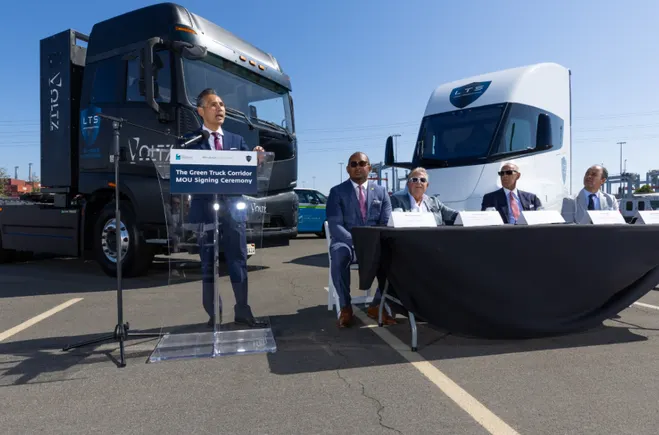
- The Port of Long Beach, The Wonderful Co., and Lincoln Transportation Services have signed a memorandum of understanding to jointly develop a port-driven "green truck corridor," according to a May 12 press release.
- The agreement establishes a framework for coordinated freight movement, connecting port operations, inland logistics networks, and zero-emission truck programs, aiming to improve supply chain efficiency and reduce air pollution and greenhouse gas emissions.
- The proposed route spans approximately 150 miles, connecting Long Beach, California, with the Central Valley, a freight artery that handles more than 300,000 import and export containers annually.
In-Depth Analysis
This collaboration builds on ongoing efforts to decarbonize freight in California while strengthening the connection between the state's seaports and inland distribution hubs.
The Wonderful Co., which owns brands such as Wonderful Pistachios and POM Wonderful, is one of California's largest agricultural landowners, according to its website. The privately held company, valued at $6 billion, is developing a 2,000-acre master-planned logistics center in Shafter, California, approximately 150 miles from the Port of Long Beach.
The logistics center already hosts 24 tenants, including several Fortune 500 companies such as Amazon, FedEx, and Walmart.
Prior to announcing the partnership with the Port of Long Beach and Lincoln Transportation Services, The Wonderful Co. had proposed the "Central Valley Green Corridor" project, a truck bypass route around the city of Shafter. The company said the project would reduce pollution in residential areas and alleviate congestion on Highway 99, one of the state's main north-south freight routes.
The new agreement expands this vision by connecting port operations with inland freight infrastructure and emerging zero-emission transportation networks.
"This corridor demonstrates how strategic master planning can create real, lasting impact, and reflects how this system is being built step by step through coordination, collaboration, and long-term planning, improving current efficiency while supporting the transition to cleaner freight," said Joe Vargas, president of Wonderful Real Estate Development, in the press release.
As the corridor's lead truck ambassador, Lincoln Transportation Services has ordered 300 Tesla Semi electric trucks, with an estimated range of 500 miles. The first 50 to 70 trucks are expected to be delivered in June.
Additionally, Voltz, an electric truck manufacturer affiliated with Lincoln, plans to produce 100 units, with deliveries expected to begin in the third quarter of 2027.
"By setting an example, we hope to inspire industry partners to join us in creating a more sustainable future," said Sepehr Matinifar, president of Lincoln Transportation Services, in the press release.
Supporting infrastructure at the Port of Long Beach is also expanding. The port currently has 102 charging stations and expects to add 92 more later this year to accommodate the growing adoption of zero-emission trucks.