
How do hydrogen fuel cell trucks compare with pure electric trucks?
In NACFE's 'Run on Less – Messy Middle' demonstration, Penske Logistics and Pilot used Hyundai Xcient hydrogen fuel cell trucks to showcase the technology's potential in return-to-base and long-haul freight corridors. The report notes that hydrogen fuel cells are suitable for structured refueling, zero direct emissions, and weight-sensitive cargo transport, but scarce infrastructure and high fuel costs limit their scalability.
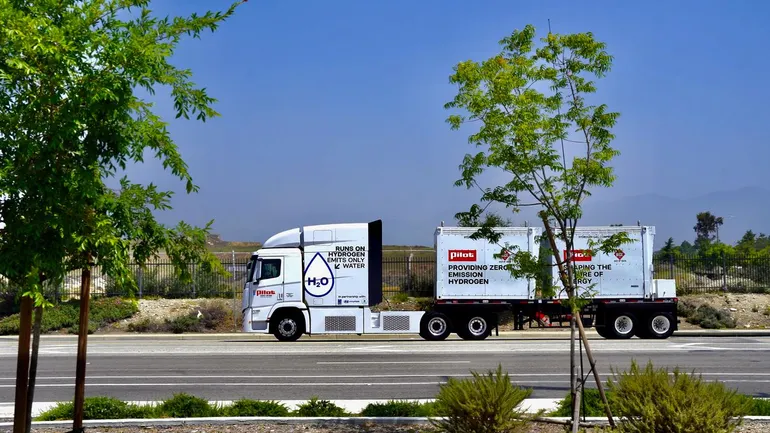
In a recent performance demonstration, hydrogen fuel cell trucks showcased their operational capabilities on daily routes and demonstrated certain advantages over battery-electric trucks. The North American Council for Freight Efficiency (NACFE), through its "Run on Less – Messy Middle" program, documented the real-world operations of Hyundai Xcient hydrogen fuel cell Class 8 tractors used by Penske Logistics and Pilot. The demonstration, conducted last year, involved return-to-base operations and long-haul freight corridors. In a report released in March, NACFE noted that these trucks "showed real operational promise," while also pointing out limitations in cost and infrastructure.
Applicable Scenarios and Operational Performance
NACFE stated in the report: "Hydrogen fuel cells are best suited for regional operations with structured refueling conditions, applications requiring zero direct emissions, and weight-sensitive freight transport—where hydrogen's weight advantage preserves more payload compared to batteries. When infrastructure aligns, hydrogen can sustain diesel-like operational patterns without long charging waits."
The study emphasized that real-world performance of diesel and alternative powertrains often differs from manufacturer claims, making actual road test data more valuable.
Two Tractors, Two Operating Environments
In the hydrogen fuel cell tractor segment, participating companies operated in different environments, showcasing varied use cases. Penske ran a triangular route in the Dallas area, centered on its auto parts distribution center in Lancaster, Texas, with largely flat terrain. Pilot's route traversed the inland foothills of Southern California, primarily in the Los Angeles area, extending from Thousand Oaks to San Bernardino and southward to Oceanside.
 Pilot's hydrogen fuel cell truck at an intersection in California (Image credit: Run on Less by NACFE)
The study noted that Penske primarily transported automotive and retail goods at night, while Pilot moved revenue-generating bulk hydrogen cargo. In terms of efficiency, the two trucks averaged approximately 7.5 and 7.8 miles per kilogram of hydrogen, respectively. Pilot benefited from California's varied terrain but was less efficient on climbs. Although the trucks were speed-limited to 56 mph, the report showed higher efficiency in the 50-60 mph range.
Efficiency Comparison Across Speed Ranges
According to NACFE data, the Hyundai Xcient tractor's fuel efficiency (miles per kilogram of hydrogen) in real-world applications is as follows:
- 0-25 mph:Penske 0.78, Pilot 2.1
- 25-40 mph:Penske 5.55, Pilot 7.7
- 40-50 mph:Penske 8.39, Pilot 10.8
- 50-60 mph:Penske 10.17, Pilot 11.5
Considering terrain, Penske achieved 7.68 and 7.94 miles per kilogram of hydrogen on flat and gently rolling roads; on 3% to 6% grades, it dropped to 5.91 miles; and on steeper sections, only 1.87 miles. Pilot's truck achieved 8.4 and 9.71 miles per kilogram on flat and gently rolling roads; on 3% to 6% grades and steeper sections, it fell to 7.05 miles and 3.24 miles, respectively.
These varying conditions highlight how the technology can be applied and how it can best be integrated into logistics networks.
Subsequent Company Developments
Meanwhile, Pilot told Trucking Dive that it has exited hydrogen fuel cell truck operations this year but will continue researching and developing its alternative fuel offerings. Penske Logistics' hydrogen vehicle pilot has also concluded, but the company stated it will continue testing and evaluating new technologies—its recent launch of the Penske Fleet Lab being a case in point.
Driver Feedback
Beyond terrain and infrastructure factors, drivers also provided feedback on the tractors' real-world performance. Christopher Rawles, who drove for Penske, said the vehicle was very easy to operate, "You don't hear anything, and you don't feel any vibration," he described in the report. David Bickmeier, who drove for Pilot, described the learning curve for maximizing vehicle efficiency. Initially, he averaged about 5.9 miles per kilogram of hydrogen, but improved quickly.
"There's a right way to drive a hydrogen truck," Bickmeier told NACFE, "Once I learned how to drive it, I now get 9.1 miles per kilogram."
 A Penske Logistics driver stands next to a hydrogen fuel cell truck (Image credit: Run on Less by NACFE)
Despite these advantages, the technology may face higher costs in the coming years, primarily constrained by insufficient infrastructure. NACFE concluded in its report: "The weight advantage and operational flexibility offer real benefits; however, scarce infrastructure and high fuel costs currently limit hydrogen to demonstration-scale deployments, requiring significant coordination between fleets and infrastructure."